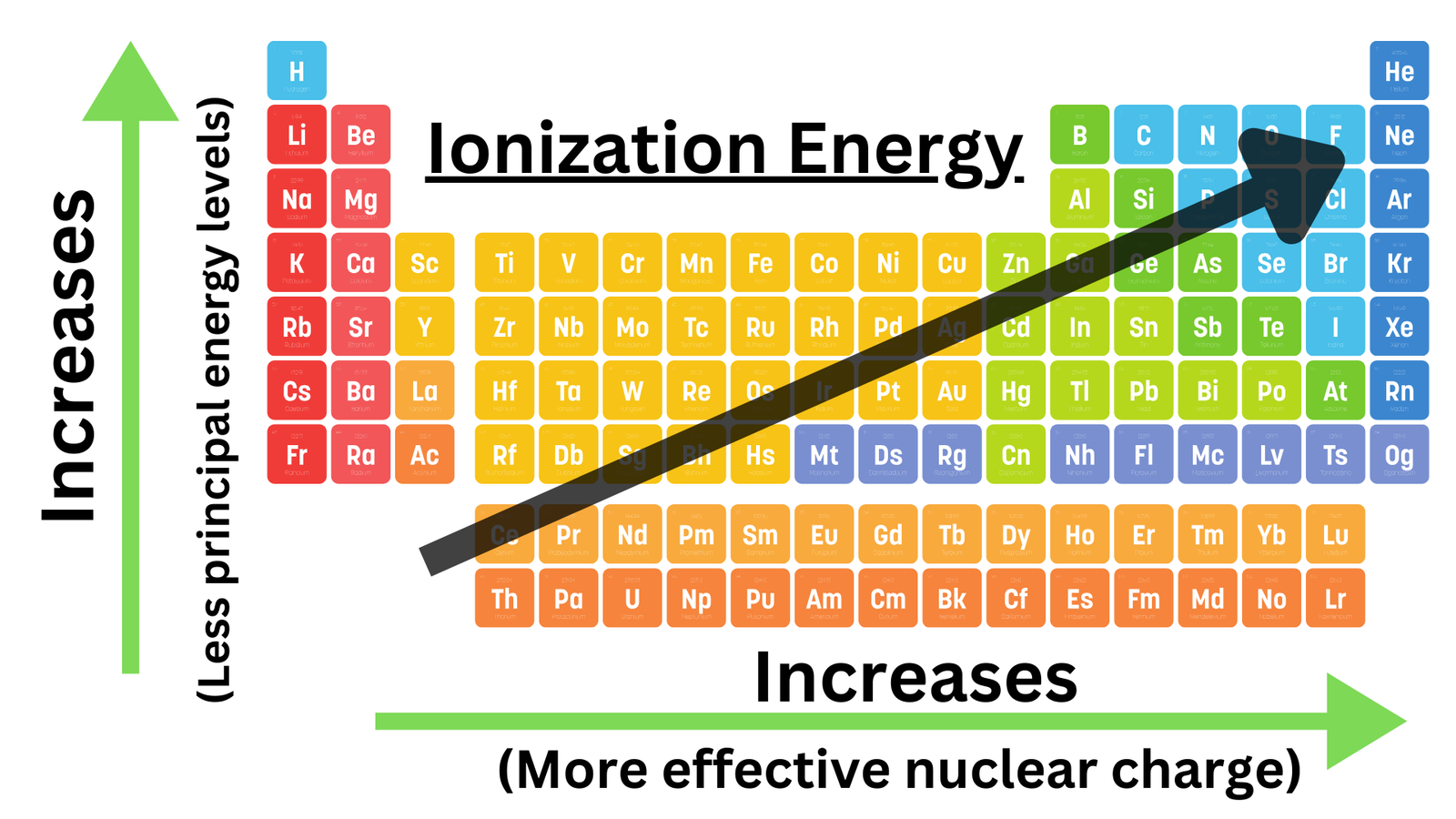
Have you ever wondered why some things stick together while others fall apart easily? Everything around us is made of tiny building blocks called atoms. Inside these atoms, there are even smaller pieces called electrons that zoom around like little planets. Sometimes, an atom loses one of these electrons, but it takes a bit of “muscle” or energy to pull it away. This “muscle” is what scientists call ionization energy. Understanding the ionization energy trend helps us predict how different elements will behave when they meet each other. It is like knowing which friend is most likely to share their toys and which one wants to keep them forever.
What Exactly is Ionization Energy?
To understand the ionization energy trend, we first need to know what we are measuring. Imagine you are holding a balloon on a windy day. If you hold the string tightly, it is hard for the wind to blow it away. If you hold it loosely, the wind snaps it up instantly. Ionization energy is the amount of work needed to pull an electron away from an atom. If an atom has a high ionization energy trend value, it means the atom is holding onto its electrons very tightly. If the value is low, the atom lets go of its electrons quite easily. This simple idea helps us understand chemistry in a much deeper way.
Why Does the Ionization Energy Trend Matter?
You might ask why we need to study the ionization energy trend at all. Well, this trend is like a map for scientists. It tells us how reactive an element might be. For example, some metals like sodium are very eager to give away electrons. This makes them very reactive and even explosive in water! On the other hand, gases like neon are very “selfish” and keep their electrons to themselves. By looking at the ionization energy trend, we can guess how a new material might act before we even touch it in a lab. It makes science safer and much more predictable for everyone.
Exploring the Periodic Table Map
The periodic table is not just a bunch of random boxes. It is organized very carefully. When we talk about the ionization energy trend, we usually look at two directions: left to right and top to bottom. As you move across a row, the atoms get a bit smaller and the center of the atom pulls harder on the electrons. This increases the ionization energy trend as you move toward the right side. It is like a magnet getting stronger as you get closer to it. Understanding these directions makes the whole table feel much less confusing and way more like a fun puzzle.
Moving from Left to Right
When you walk across a row on the periodic table, the ionization energy trend goes up. This happens because the middle of the atom, called the nucleus, gets more positive “power.” This extra power acts like a stronger glue that holds the electrons in place. Because the electrons are held so tight, you need much more energy to pull one off. This is why the elements on the far right, like Helium, have the highest ionization energy trend values. They are the champions of holding onto their stuff! It is a very consistent pattern that scientists rely on every single day.
Going Down the Columns
What happens when we move from the top of the table to the bottom? In this case, the ionization energy trend actually goes down. This is because atoms get bigger as you go down. Imagine trying to hold hands with someone who is standing ten feet away versus someone standing right next to you. The farther away the outer electrons are from the center, the easier they are to lose. This is why the ionization energy trend decreases as we add more layers to the atom. Bigger atoms are simply “looser” with their electrons than the small, tight atoms at the top.
The Shielding Effect Explained
One reason the ionization energy trend changes is something called “shielding.” Think of the nucleus as a bright light and the electrons as people trying to see it. If there are many rows of people in front of you, it is hard to see the light clearly. In large atoms, the inner electrons block the “pull” from the center. This makes the outer electrons feel less of a grip. This shielding is a big reason why the ionization energy trend drops as atoms get larger. It is a protective layer that lets the outer electrons wander off more easily than they would otherwise.
Small Atoms vs Big Atoms
Size really does matter when it comes to the ionization energy trend. Small atoms have their electrons very close to the center. This makes the attraction very strong. Big atoms have electrons that are far away and shielded by other layers. Therefore, small atoms usually show a high ionization energy trend while large atoms show a low one. You can think of it like a small house where you can hear everything versus a giant mansion where someone in the basement can’t hear the doorbell. The distance changes how much control the center has over the edges.
A Helpful Data Table
To make this easier, let’s look at a simple table. This shows how the ionization energy trend changes with common elements. You will notice that as the atomic number changes, the energy needed follows a very specific path.
| Element Name | Symbol | Position | Ionization Energy Level |
| Hydrogen | H | Top Left | Medium-High |
| Lithium | Li | Left Side | Low |
| Neon | Ne | Far Right | Very High |
| Cesium | Cs | Bottom Left | Very Low |
| Helium | He | Top Right | Highest |
Real-Life Examples of the Trend
We see the ionization energy trend in action all the time! Think about the batteries in your toys or phone. Many batteries use Lithium. Why? Because Lithium has a low ionization energy trend value. It gives up electrons easily, which creates the flow of electricity we need to power our gadgets. On the other hand, we use Noble Gases like Argon in lightbulbs because they have a high ionization energy trend. They won’t react with the hot metal inside the bulb. This keeps the bulb from burning out too fast. Science is everywhere in our homes!
My Personal Thoughts on Atoms
I think the ionization energy trend is one of the coolest parts of chemistry. It shows us that nature follows rules, even at a level so small we can’t see it with our eyes. When I first learned about this, I thought it was amazing that a simple grid could tell us so much about the universe. It makes me feel like the world is a very organized place. Even though atoms are invisible, the ionization energy trend gives us a way to “see” how they work. It is like having X-ray vision for the building blocks of life itself.
Summary of the Ionization Energy Trend
To wrap things up, the ionization energy trend is a pattern that tells us how hard it is to remove an electron. It increases as you move to the right of the periodic table because the center of the atom gets stronger. It decreases as you move down the table because the atoms get bigger and the outer parts are farther away. Remembering this ionization energy trend makes you look like a total science pro! It is the key to understanding why chemicals mix the way they do and how our modern technology functions every day.
Frequently Asked Questions
What is the simplest way to define the ionization energy trend? It is the pattern that shows how much energy is needed to pull an electron away from an atom. It changes based on where the atom is on the periodic table.
Which element has the highest ionization energy? Helium has the highest value because it is small and its electrons are very close to the center. It does not want to let go of them at all!
Why does the trend go down as we move down a group? As you move down, atoms get more layers. The outer electrons are further from the center and are easier to pull away, so the energy needed is lower.
Does atomic size affect the ionization energy trend? Yes! Generally, smaller atoms have higher ionization energy, and larger atoms have lower ionization energy. The distance from the nucleus is very important.
Is ionization energy the same as electronegativity? No, but they are related. Ionization energy is about losing an electron, while electronegativity is about how much an atom wants to gain or attract one.
Why do metals have low ionization energy? Metals are usually on the left side of the table. They have fewer protons pulling on their electrons, making the ionization energy trend lower for them.
Conclusion
Now that you know all about the ionization energy trend, you are ready to explore more! Chemistry is like a giant mystery waiting to be solved. If you found this helpful, why not look at a periodic table and try to guess which elements are the strongest? The more you look, the more patterns you will find. Science is a journey, and you just took a huge step forward. Keep asking questions and stay curious about the amazing world of atoms!