Every pool owner discovers the same truth within the first few weeks: a swimming pool is not just something you own, but something you care for. The water changes daily. Heat burns off chlorine. Rain shifts the chemical balance. Leaves, sunscreen, and sweat all add to the load.
Without a steady routine, small problems turn into expensive repairs.
The good news is that pool care follows a predictable system. Industry professionals often refer to the 4 C’s — chemistry, cleaning, circulation, and equipment care. Master these four areas, and your pool stays swim-ready with consistent, manageable effort.
Water Chemistry: The Foundation of Everything
Most pool problems begin with unbalanced water. Algae blooms, cloudy water, equipment corrosion, and skin irritation are almost always symptoms of chemistry that has drifted out of range. Three numbers control the rest.
pH should sit between 7.4 and 7.6. At 8.0, chlorine drops to under 20% effectiveness.
Free chlorine needs to stay between 1 and 3 ppm to kill bacteria and algae.
Total alkalinity buffers pH and should read 80 to 120 ppm.
Correct alkalinity first — pH adjustments will not hold until alkalinity is in range.
Test pH and free chlorine two to three times per week. Test alkalinity weekly for the first month, then monthly.
Calcium hardness and cyanuric acid should be tested once per month.
Cyanuric acid helps chlorine last longer in sunlight, but levels above 80 ppm mean partial draining is the only fix.
Physical Cleaning: Sequence Matters
Physical cleaning removes debris, algae, and sediment that chemistry and filtration cannot handle alone.
The order of tasks makes a real difference: chemistry first, then empty baskets, skim the surface, brush walls and steps, wait 10 to 15 minutes for debris to settle, then vacuum the floor last.
Brushing before vacuuming is not optional.
Dead zones — corners, steps, behind ladders, around light fixtures — collect algae before it becomes visible anywhere else. Brush these areas first.
A full manual cleaning session takes 45 to 90 minutes.
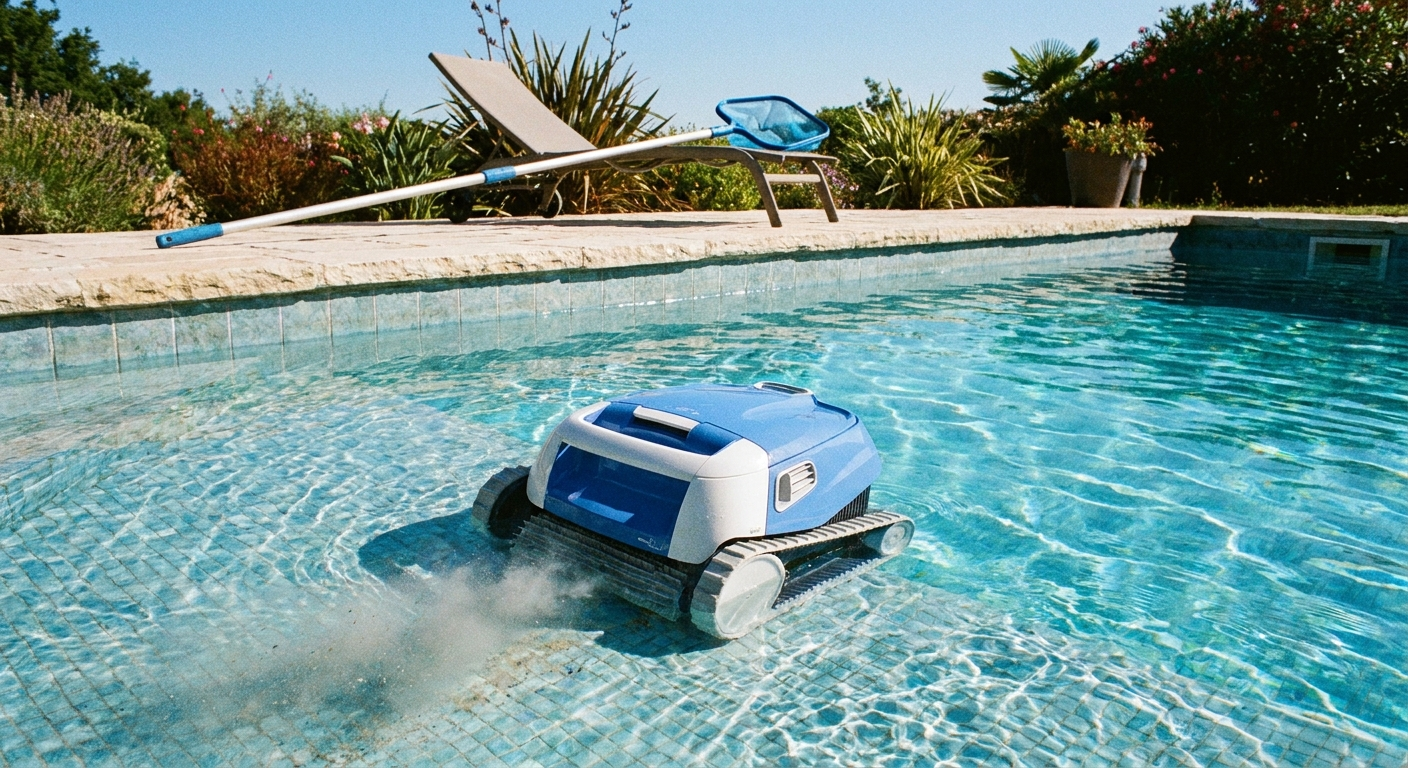
With a robotic cleaner handling the floor and walls, the active portion drops to 15 to 25 minutes.
Filtration and Circulation: The Unseen Workhorses
Filtration and circulation distribute chemicals evenly and remove particles that chemistry alone cannot clear. A pool with correct chemistry but poor circulation will still develop algae in dead zones. A clogged filter strains the pump and reduces flow across every other task.
Run the pump 8 to 12 hours daily during daylight hours, not overnight.
Backwash when pressure rises 8 to 10 psi above the clean baseline. Sand and DE filters use a valve-based backwash sequence.
Cartridge filters do not backwash — remove, rinse, soak in cleaning solution, and reinstall.
A cartridge that no longer returns to within 1 to 2 psi of its baseline needs replacing; most last two to three years.
Equipment Care: Catch Problems Early
Equipment problems develop gradually through wear and neglect. By the time a symptom is obvious, the repair is already more expensive than it needed to be. Monthly checks catch problems when a simple service still fixes them.
The pump lid O-ring is the most commonly skipped item.
A dry or cracked O-ring lets air into the suction line and causes the pump to lose prime.
Check monthly, lubricate if dry, replace at the first sign of cracking.
A pump that runs dry, even briefly, can damage the mechanical seal and impeller.
After each cleaning cycle with a robotic cleaner, empty the debris basket, rinse the filter media, and check brush wear. Worn brushes leave debris on the floor perimeter. Store the cleaner out of direct sunlight and bring it indoors before winter.
A Weekly Schedule That Works
A reliable routine is built around frequency. Breaking tasks across the week keeps the workload light and prevents problems from building up.
On Monday, skim the surface and brush walls and steps.
On Wednesday, run the robotic cleaner and check pump pressure.
On Friday, test water chemistry and adjust chlorine and pH as needed.
On the weekend, do a visual inspection — check for cracks, water level, and filter pressure.
Consistency matters more than perfection. A steady routine keeps debris from piling up, keeps chemistry from drifting, and makes every cleaning day faster.
For a deeper reference on every aspect of pool ownership — from water chemistry troubleshooting to seasonal winterizing and equipment care — consult iGarden’s pool owner handbook. It consolidates the essential knowledge every pool owner needs into one practical guide.
Troubleshooting Common Problems
Most pool problems have a clear cause-and-effect chain. Diagnose the root cause rather than treating the symptom, because the symptom returns if the underlying condition remains.
Cloudy water is almost always a chemistry issue.
Test pH first — above 7.8, chlorine loses effectiveness regardless of the reading. Green water signals an active algae bloom. Correct pH to 7.2 to 7.4 first, then shock.
If the water does not clear within 48 hours, test cyanuric acid.
A chemical smell or skin irritation usually means high chloramine levels, not too much chlorine. Sweat, sunscreen, and body oils combining with chlorine are the source. Super chlorination breaks down the buildup in one concentrated dose.
Seasonal Care for Long-Term Health
Seasonal tasks keep chlorine steadier as sun and swimming increase.
At the start of the season, clean the cover, reconnect equipment, refill, and run the pump for 24 hours.
Adjust pH first, then alkalinity, chlorine, calcium, and cyanuric acid.
Shock the pool and run the filter for 48 hours while brushing all surfaces.
At closing time, balance chemistry two to three days before winterizing. Shock the pool, clean the filter, drain water below return lines, add winterizing algaecide, and cover the pool securely.
With a consistent approach to the 4 C’s — chemistry, cleaning, circulation, and equipment care — pool ownership becomes a manageable routine rather than a source of stress. The water stays clear, the equipment lasts longer, and the pool remains ready whenever you are.